
What is Imbalanced Dataset
Machine learning is often used for prediction. Using the data for training, it produces valuable information that is difficult to capture.
It is hard to believe that when more data is collected, achieving this goal is increasingly more challeging. That’s because data is not clean, and it requires hours of EDA work to make the data usable. Another common problem data scientists are faced with is imbalanced dataset.
A imbalanced dataset is when one classification significantly outweights the other.
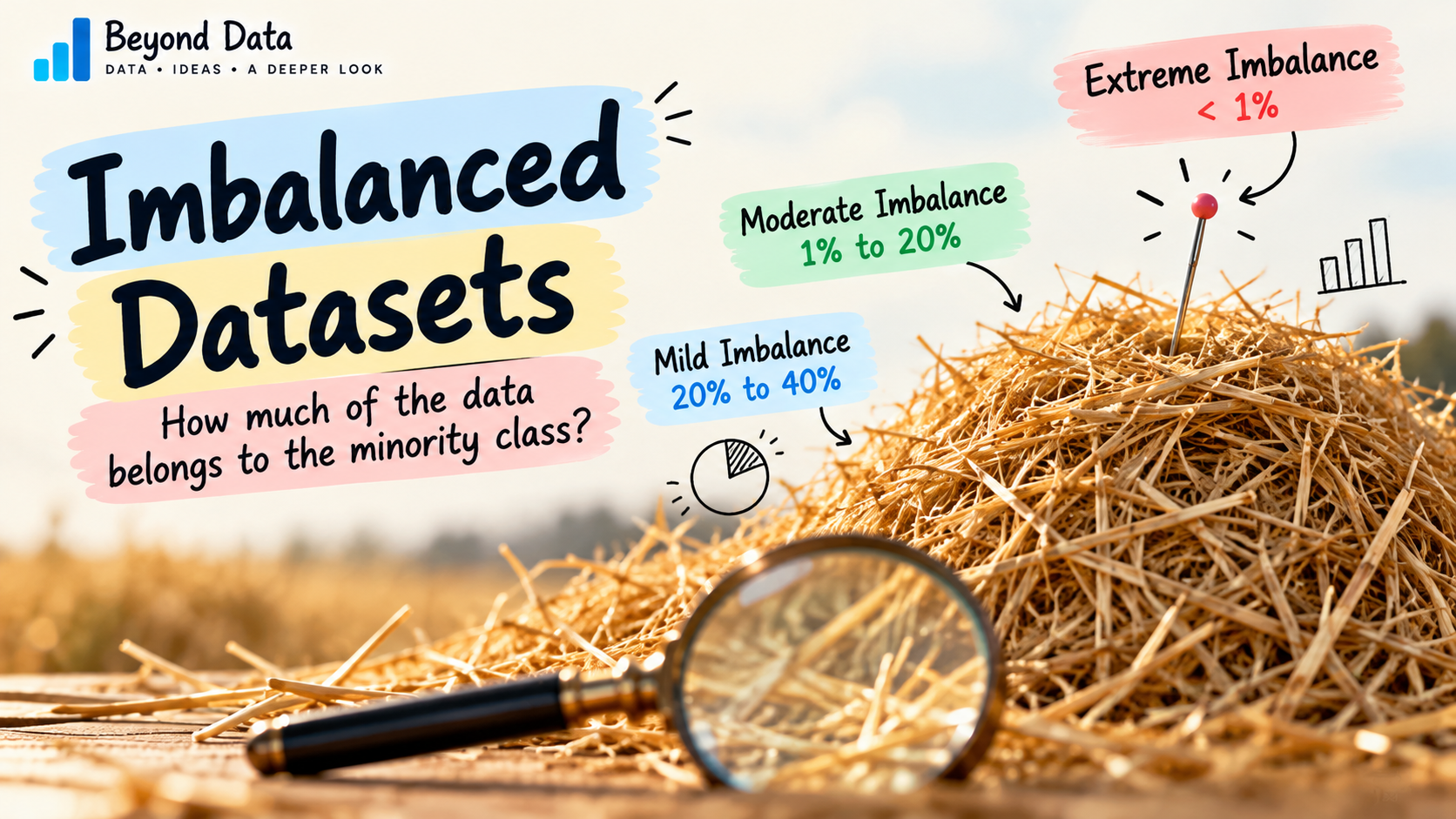
Imagine a model is built to find the needle in a haystack. Suppose, you have a dataset with a 1000 rows, and 999 have been labeled as haystraw and 1 as needle. So, 0.001 is positive.
The dataset is imbalanced.
In this article, we will explore why imbalanced datasets are a problem, and techniques for handling these imbalanced datasets.
Understanding the Basics
In essence, a dataset is considered imbalanced when one classification (haystack) significantly outnumbers the other (needle). While this issue can happen in just about in any dataset, the term is usually in context of binary classification.
An imbalanced dataset is suprisingly common. Take fraud detection where a very small percentage of the transactions are fraudulent. Likewise, in the medical industry, diseases like cancer or rare genetic conditions affect such a small population that is statistically insignificant. Or even emails; only a very small portion are spam.
Why Imbalanced Datasets Are Problematic?
Machine learning, by nature, expects that the data is evenly distributed across classes. When it encounters something like the needle in a haystack example, it doesn’t have enough instances to learn, and it becomes bias.
What makes it particularly difficult to work with a imbalanced dataset are the metrics used to ensure the model is working. Under normal circunstances, the first item I would consider is accuracy. Depending on the application, a 70% accuracy is a great result. But if a model is detecting fraud transactions flags nothing, it still have a accuracy of 98% or even more. Similarly, the sensitivity, or recall, for the minority class will be most likely bt low, failing to identify many true instances.
All these factors pose as a problem making imbalanced dataset analysis challenging.
But how do you check for a imbalanced dataset?
Checking for Imbalanced Dataset
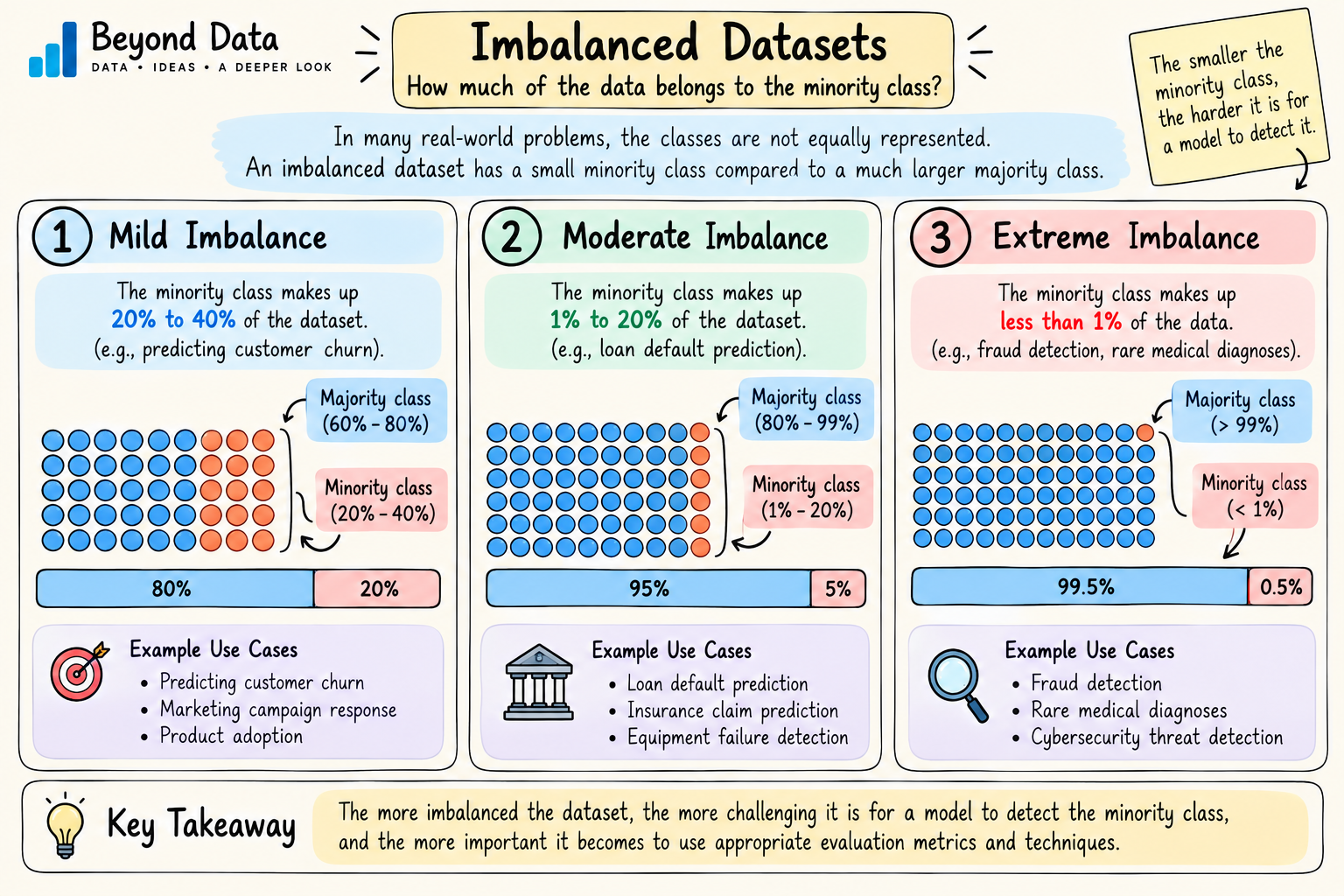
There isn’t a one size fits all. Anytime your dataset have a split of 20/80 or worse is imbalanced. But there is more to the story. The threshold varies depending on the application. Datasets generally fall into three tiers of imbalance.
Mild: The minority class is somewhere between 20% to 40% of the dataset.
Moderate: The minority class makes up 1% to 20% of the dataset.
Extreme: This the needle in the haystack, where the minority makes up less than 1% of the data.
This is in the binary context. When you are dealing with multiple classes, checking the imbalance is a little more complex and a topic for another time.
Techniques for Handling Imbalanced Datasets
Several techniques are available for working with these imbalances. Here are some of the most common methods:
1. Resampling Technique:
Resampling technique involves increasing the number of samples in the minority class by duplicating them or creating synthetic samples using SMOTE (synthetic minorite over sampling technique).
Conversily, undersampling the majority class could also be on an option if all the other factors are right. This technique reduces the number of samples in the majority class, balancing the dataset.
2. Use Appropriate Evalution Metrics
Precision, Recall, and F1-Score are some of the most common metrics that provide a clear picture of the model performance.
ROC-AUC is useful metric that evaluates how well the model distinguish between the classes. The final metric is the Confusion Matrix. It helps visualize the number of true positives, true negatives, false positives, and false negatives, giving a deeper insight into the model performance.
3. Algorithm-Level Solutions
The algorith can be modify to give a higher importance to the minority class, forcing the model to focus more on correctly classifying the minority samples.
Algorithms like Random Forest, Gradient Boosting, and XGBoost can be effective for handling imbalanced datasets, especially when combining with resampling. But not a silverbullet, before committing, all of the metrics should be evaluated.
4. Anomaly Detection
In some cases, instead of trying to balance the dataset, you can approach the problem as an anomaly detection task. That way, the algorithm treats the class an an anomaly or outlier.
Best Practices Working with Imbalanced Datasets
Before applying any technique, understanding the problem is paramount. Some cases are inherintly rare, like fraud detection.
Always use cross validation to ensure that your model generalizes well to unseen data. But most importantly, there is No Free Lunch, no one size fits all. When dealing with a imbalanced dataset, experimenting with multiple techniques and various metrics to find what works best for the dataset is the name of the game.
Conclusion
Imbalanced dataset are part of the day to day of a data scientist. Using the techniques highlighted in this post can help you work around and find solutions to this problem.
No comments yet. Be the first.