
The AI Bubble Nobody Wants to Talk About
There isn't one day when I open the news or social media that I don't come across AI news.
There isn’t one day when I open the news or social media that I don’t come across AI news.
Last week I tried something different. I connected my computer to a VPN server in the Midwest and, with my browser in private mode, checked Google News and other news outlets. The results were the same.
AI has been making headlines consistently since the launch of ChatGPT in November 2022. The speculations about its development and where it is going are insane.
Not to mention the doomsday predictions by talking heads and SME warning us of the possible extinction of mankind.
If it is not doomsday, we have others talking about the end of white-collar jobs.
I’m not understating the power of AI. It is a powerful tool and, without proper guardrails, it can be very detrimental in many ways.
But there are a couple of elements of the technology that aren’t being discussed nearly enough.
Today, AI is on steroids, and it is growing at an unsustainable rate. At some point, the dream is going to be over, and all the predictions are going to fall flat.
Powering Data Centers
First, there is a growing opposition to data centers. Over 140 activist groups are blocking the construction or expansion of these data centers.
An LLM requires massive amounts of data for training. Without the data centers to house their needs, the growth is limited.
Building data centers is not the only problem AI companies are facing. Powering them is also a problem.
Residents have reported that when a new data center comes to town, their power bills increase sharply. Some areas have seen an increase in electricity costs of as much as 267%.
Americans are already suffering financially, with debt delinquency hitting records. How would an increase of 200% in the power bill be received by most of the working class?
In Wyoming, AI is on track to consume 5x more power than all the homes in the state combined.
As more companies and people adopt AI, energy demand will only increase.
Experts are warning that energy will soon become an AI bottleneck, reaching a breakpoint.
AI Usage
While the general US population has been quick to jump on the bandwagon and implement AI in just about every aspect of their lives, the same cannot be said about the rest of the world.
About 84% of humans have never used AI. I was shocked when I read that. The graph below was published by Julius Nyerere Nyambok late last month.
The gray squares, representing about 3.2 million people, represent the population that has never used or interacted with AI.
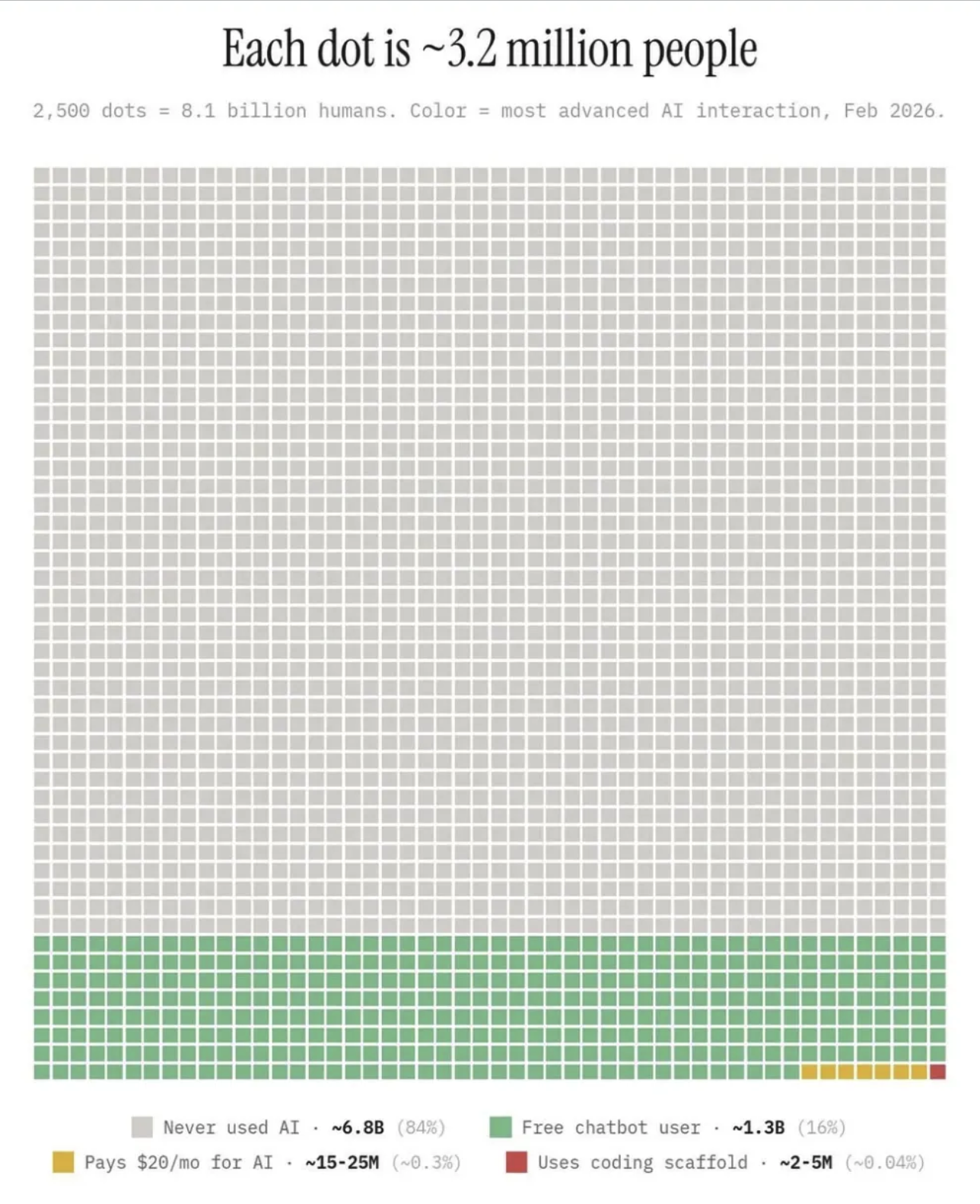
But there is something else in this graph that caught my attention. The number of free users. That’s about 1.3B people who are reaping the benefits of AI without spending a single dollar.
The folks who are willing to pay the $20/month are no more than 25M people. And not even one square is for the people who pay the extra premium.
Which leads me to the last and most critical point.
No AI Company is Making Money
Since the 70s, US companies have been obsessed with profits. They disregard people and anything else that gets in the way of their money. Yet, no AI company has turned a profit since 2022.
While they are showing some revenue growth, their expenses dwarf their income.
The question is, how patient are the investors? At what point will they stop the bleeding?
In a world where investors are violent sharks that hate to take losses, not turning a profit is a huge red flag.
There is something else. Another red flag.
Despite huge investments, according to Goldman Sachs, the AI industry has had basically zero impact on the US GDP.
Conclusion
The AI industry has a huge uphill battle. They are stuck in a catch-22 right now.
More users mean more money, which means more investment, which means more energy. And energy is about to be a problem in the very near future.
You might be wondering, who the hell is this guy, and why should I listen to him? Where are his credentials?
You got me. I have no credentials to talk about any of this. But after decades of business analysis and working with data, I have developed an invaluable skill. I can put things together very quickly.
I don’t need to be an expert to hear or see the train approaching the station. Or to feel the ground vibrating. I pick up on the cues and know the train is near.
Unless there is a solution to these problems, AI will be no different than a dotcom bubble.
No comments yet. Be the first.